
Featured on The Good Life Magazine: Growing Up Panelli
Check out Dr. Rich Panelli and his family featured in this month’s The Good Life magazine!

When Dr. Rich Panelli talks about his childhood and family, his face lights up. He shared, “My dad, Rick, passed away in 2018 after battling cancer for 20 years. He was a huge influence in my life. He was stationed in South Korea in the Air Force and when he returned to Reno,
he opened an Italian restaurant, Spaughi’s, with my mom.”
Spaughi’s, a play on Rick’s childhood nickname, “Spaghetti Boy” also served as Panelli’s part-time, childhood home. “We lived at the restaurant, and after it would close, they had Late Night Jazz. So, people from Harrah’s who had just performed that night would come over. I was eight years old, watching people like Sammy Davis, Jr. playing with Diana Ross in this tiny room,” he said.
Panelli’s mother Mary, a former archaeologist, led the Donner Party excavation team; and spent time as an instructor at the University of Nevada, Reno. She later volunteered with the Red Cross in Lake Charles, LA, following Hurricane Katrina.
“My childhood was interesting and exciting,” Panelli said. “My parents have always been a major part of my life; my dad until his passing, and my mom and stepdad (Tom), still.”
Panelli is a third-generation Reno native. He graduated from Utah State University in 1999 with a Bachelor of Science degree in communicative disorders. While attending school at Utah State, Panelli participated in track as a Division I athlete, from 1996 to 1999. In 2002, he graduated from the University of Utah with a Master of Science in audiology. He completed an internship at the Veteran’s Administration Medical Center in Salt Lake City, Utah in 2002.
Panelli returned to Reno after college, and shortly after joined LIGA International: The Flying Doctors of Mercy. He volunteered in six clinics for hearing impaired children in Sinaloa, Mexico, between November 2004 and June 2006. The following year, Governor Jim Gibbons appointed Panelli to serve on the Nevada State Hearing Aid Specialists Licensing Board. In March 2009, Panelli graduated from A. T. Stills University, Arizona: School of Health Sciences, earning a Doctorate degree in audiology.
Panelli continues his volunteer work in Reno. He has been a guest lecturer at UNR’s School of Medicine, and he supports many charitable organizations, including Rain Shadow Charter School, The Holland Project, The Evelyn
Mount Foundation, C.A.R.E. Chest of Northern Nevada, and Koinonia Foster Homes.
Panelli holds a Certificate of Clinical Competence in Audiology from the American Speech-Language-Hearing Association, and is a member of that organization. He also is a Fellow of the American Academy of Audiology.
“I enjoy the ENT aspect of my job because you get to see
so many different things. There’s anything from vertigo and ringing in the ears, to hearing tests on kids, assessing sudden hearing loss, and brainstem testing,” said Panelli, who works at Nevada ENT and Hearing Associates. “In a sense, it’s like an emergency room for audiology because you never know exactly who is going to walk in the door.
Panelli’s dedication to his profession is evident, but it is family that inspires him, most.
“I was born on my dad’s birthday and he was born on his dad’s birthday. My dad always used to tell this story about my grandmother who came into the family restaurant over a year before I was born to share some exciting news,” Panelli remembered. “It was a super busy night, but she dragged my dad into the back room to tell him that he was going to have a son.” She told Panelli’s father that the child would be born on his birthday. “He asked how she knew
and she only said, ‘I had visitors.’ Three days later she suddenly died.”
Panelli is married to Jill, a former journalist and dance teacher. They met when they were kids, through Panelli’s cousin, Maria, who was Jill’s childhood best friend. Panelli was at the University of Utah when his cousin stopped for the night, on her way to grad
school. Jill was traveling with her, and that’s when they became reacquainted. “We’ve basically never looked back,” said Panelli. Jill is a sixth-grade teacher at Billinghurst Middle School. The couple has two sons, Nico, 12, and Rocco, 9. Nico is a multi-sport athlete, just like his dad. “Rocco is the more artistic, imaginative type of kid,” said Panelli. “He writes movie scripts and then acts them out.”
The Panellis enjoy going to movies, working out, and spending time at the family cabin at Lake Tahoe. Panelli said he and Jill best love watching their boys’ sporting and acting events. “Growing up, my dad never missed any of our games or practices, even in hard times. He never missed anything. Jill’s parents were the same way. We are all very family-centered. Faith is also important to us. Really, it’s just about being there for our family and giving our
kids everything we can,” said Panelli, his face lighting up, again. “Our boys are the best.”


Check out Dr. Josh Meier on KTVN’s Ask the Doctor – Protect Yourself From Wildfire Smoke!
Our practice is honored to have been named as a winner in the Hearing Aid Center category of Best of Reno 2021. Thank you so much Reno! We are happy to serve each and every one of our patients!
Having a smoke detector in place is a simple, hugely effective strategy to prevent yourself from harm: Your risk of dying in a fire in your home falls by 55 percent when there’s a working smoke alarm present, per the National Fire Protection Association (NFPA).
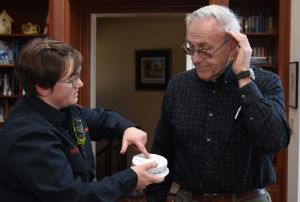
to hear standard smoke detector alarms.
(Photo courtesy FEMA)
And for many people, the attention-grabbing blare of a fire alarm is all you need. If you have impaired hearing, though, the din of these life-saving devices may not be an effective alert to the presence of smoke, fire or carbon monoxide.
Alarms with flashing lights, as well as special vibrating alarms designed to wake someone who’s sleeping, are available for people who are deaf or have a hearing impairment.
Here’s what you need to know to ensure you have an alarm that provides you with the alert you need.
Why it matters
“Today more than ever, it’s important for residents to have the earliest possible notification of an emergency,” says Sharon Cooksey, a fire safety educator at Kidde, an alarm manufacturer.
That’s because escape time is lower now than previously needed—just two to three minutes—due to more fast-burning synthetic materials in homes, she says.
“This makes a quick evacuation a top priority,” Cooksey notes.
People at the highest risk of being harmed or dying in a fire include children, people who are under the influence of drugs/alcohol, and people with hearing loss, statistics show.
Choose a smoke alarm that’s suitable for your hearing loss
If you have high-frequency sensorineural hearing loss due to either age or noise exposure, an ordinary alarm may not give you the alert you need, says audiologist Rich Panelli of Nevada ENT.
“The risk of a normal alarm is that some produce only a high-frequency sound, and some do not produce an alarm loud enough for [people with] a severe to profound hearing loss to pick up,” Panelli says.
This is particularly significant at night, when people are likely to remove their hearing aids.
“NFPA advises that older adults or other people who are hard of hearing (those with mild to severe hearing loss) can use a device that emits a mixed, low-pitched sound,” Cooksey says.
Smoke alarms when you’re hard of hearing: Options
There are a few different options available, including:
- Strobe lights: Instead of relying simply on sound, the flash from strobe alarms gives a visual cue about dangers. If you’re counting on a strobe alarm for nighttime, when you might be asleep, look for one that has an intensity high enough to wake someone up, advises the NFPA. And be aware that older adults may be less responsive to strobe alarms, Cooksey points out.
- Vibration: Sleeping is a particularly high-risk time when it comes to fires. Fires during sleeping hours, between 11 p.m. and 7 a.m. account for 47 percent of fatal fires in residences, according to FEMA. Alarms that make the pillow or bed vibrate (often referred to as “bed shakers”) help wake people up.
- Interconnected alarms: “Alarms that cater to someone with severe to profound hearing lossinclude a combination of alerting devices, usually in one system,” Panelli says. With this system, when one alarm goes off, all of them do—the bed shakes, lights flash, sounds blare, and so on.
Whichever alarm system you select, make sure everyone in the house knows what signal (whether it’s light, sound, vibration, or a combo) to expect, Cooksey recommends.
What to look for in alarms for people with hearing loss
It can be helpful to connect with your hearing specialist to ask what type of alarm they believe is best-suited for your particular type of hearing loss. “When considering alerting systems, it is important to remember every patient is unique,” Panelli says.
Here’s what else to keep in mind when it comes to fire alarms:
- You need more than one. If you have several floors, you’ll need an alarm in each level (except for the attic), Cooksey says. Make sure to have one in every bedroom, she says.
- You’ll need to test them regularly. That way, you’ll know the alarm is working. Cooksey recommends a weekly test.
- Make sure the alarm is reputable. “Always look for alarms that have the label of a recognized testing laboratory, such as UL,” Cooksey recommends. You’ll find alarms that meet the UL standards for people who are deaf or hard of hearing from BRK Electronics, Gentex Corporation, Kidde Fire Safety, and Menards, Inc., notes the NFPA.
Note: This guidance is for households. People who own businesses like hotels must follow ADA laws.
CO detectors for people with hearing loss
Carbon monoxide, or CO, is a colorless, odorless gas produced from fossil-burning fuels used in furnaces, boilers, water heaters and fireplaces. Depending upon where you live, state or city laws may require you to have a working CO detector installed in your home. Even if they don’t, it’s a good idea to have one. Experts recommend installing a CO detector at least 15 feet from the entrance of each bedroom as well as one on every level of your home.
Much like smoke alarms for individuals with hearing loss, carbon monoxide detectors are available with strobe lights and vibrating devices. NFPA codes also apply to these devices, which means these appliances must emit a loud, low-frequency signal.
For more information, see the NFPA’s page on fire safety and hearing loss.
See full article here.
 Nevada ENT and Hearing Associates announced April 19 that Reno Tahoe Sinus Center founder Dr. Josh Meier has been named a Fellow of the American College of Surgeons (FACS).
Dr. Meier was among 1,993 surgeons from around the world to be initiated into the American College of Surgeons (ACS), according to a press release. Dr. Meier brings a highly specialized approach to the area, as he most-senior-fellowship trained rhinologist in Northern Nevada and Northeastern California. Dr. Meier is also the only Fellow of the American Rhinologic Society (FARS) in Nevada.
Dr. Meier is a Northern Nevada native who relocated with his family to practice medicine in his home state. He graduated from medical school from the University of Southern California at the top of his class.
Dr. Meier completed his residency training at the Massachusetts Eye and Ear Infirmary in the Harvard Combined Program in Otolaryngology — Head and Neck Surgery. He then completed a rhinology fellowship (endoscopic sinus and anterior skull base surgery) at Harvard Medical School and MEEI. In 2017, Dr. Meier founded Reno Tahoe Sinus Center.
The ACS is a scientific and educational organization of surgeons that was founded in 1913 to raise the standards of surgical practice and to improve the quality of care for the surgical patient. The College is dedicated to the ethical and competent practice of surgery.
Its achievements have established it as an important advocate for all surgical patients. The College has more than 82,000 members and is the largest organization of surgeons in the world.
An applicant for Fellowship must be a graduate from an approved medical school; must have completed advanced training in one of the 14 surgical specialties recognized by the College; must possess certification by an American surgical specialty board or appropriate certification by the Royal College of Physicians and Surgeons of Canada; and must have been in practice for at least one year.
Prior to admission into Fellowship, the surgeon must further demonstrate ethical fitness and professional proficiency, and his or her acceptance as a Fellow of the College must be approved by three-fourths of its Board of Regents.
Read More: https://www.nnbw.com/news/2021/apr/29/people-dr-josh-meier-named-fellow-american-college/
Dr. Josh Meier M.D. F.A.R.S. F.A.C.S. recently gave a virtual presentation for Renown Health‘s General Education Rounds! He presented “Rhinology 2021: Chronic Sinusitis and Beyond”
Dr. Josh Meier reflected on the healthcare industry and lesson learned from the pandemic.
In February 2020, we shook hands and hugged without hesitation. We packed into convention centers, meeting rooms, restaurants and concert halls — networking, talking, laughing and dancing less than six feet apart.
Then it all went away. In March 2020, as the coronavirus pandemic shut down Nevada and the entire nation, we started bumping elbows instead of shaking hands. We connected via Zoom rather than network in person. We relied on breweries and distilleries for hand sanitizer. We snapped up toilet paper and pasta at breakneck pace. We wore masks when we shopped.
All the while, the business community here was impacted in countless ways, big and small. Some shut down completely, others struggled to reopen, and many more found innovative ways to shift their business model to survive — and some even thrived due to a pandemic-related rise in demand.
One year later, the NNBW fielded responses from more than 20 business owners and executives in Northern Nevada — bars, banks, contractors, developers, Realtors, healthcare providers and more — to find out the biggest lessons they have learned since March 2020, and the biggest differences in how their industry now conducts business.
“There were many lessons learned last year. Our practice needed to adapt quickly and efficiently while meeting the new regulations and safety protocols. The biggest change our office made was implementing telehealth capabilities within four days to continue to provide care to our patients. Our practice didn’t offer telehealth options prior to the COVID pandemic, but we quickly realized we needed to adapt to give our patients a safer option to receive care. As with many other lessons from this pandemic, we don’t see our telehealth capabilities being discontinued.”
Read the full feature here One Year Later: Northern Nevada businesses reflect on industry shifts, lessons learned due to the pandemic.
In compliance with Governor Sisolak’s COVID-19 guidelines, we are taking the following steps in the interest of the safety of our patients, staff, and physicians for onsite appointments. We appreciate your understanding as we work to provide the highest standard of care in the safest environment possible. Our staff is available immediately to take appointments for either in-office or telehealth visits.
- All patients will be screened for symptoms of COVID-19 at the time of appointment booking, and also on both the day prior to, and the day of the visit. This screening will include a temperature check at the time of entry.
- The number of patients in the building at one time will be limited and extensive decontamination efforts in exam areas will be taken after each visit.
- All staff will wear masks at all times and we ask that patients do the same when visiting our office.
- If any patient has had symptoms consistent with COVID-19 in the 3 weeks preceding the visit, we will ask that they arrange for a telemedicine visit or see their PCP.
- We ask that those accompanying patients to our office be limited to one in the case of minors or those who need assistance only. Otherwise, we ask that only the patient themselves enter our building.
Dr. Josh Meier was featured on KTVN’s Ask The Doctor segment to discuss the loss of smell. Watch more below!
KTVN Channel 2 – Reno Tahoe Sparks News, Weather, Video
Dr. Josh Meier was featured on KTVN’s Ask The Doctor segment. Watch more below!
KTVN Channel 2 – Reno Tahoe Sparks News, Weather, Video